
AI systems that don’t just answer questions — they set goals, make plans, and take action. Here’s what that really means, and why it changes everything.
For most of its short public life, AI has been a very good answering machine. You type a question, it types back. You ask for a draft, it drafts. The human is always in the loop — initiating every action, reviewing every output, deciding every next step.
That model is changing fast.
Agentic AI refers to systems that can pursue goals across multiple steps, make decisions, use tools, and take actions in the world — without needing a human to hold their hand at each turn. Instead of responding to a single prompt, an agent receives an objective and figures out how to accomplish it.
“The shift from AI as a tool to AI as an actor is one of the most consequential transitions in the technology’s history.”
What makes AI “agentic”?
The term gets thrown around loosely, but agentic systems share a few defining characteristics. They can break a large goal into subtasks. They can call external tools — web search, code execution, APIs, file systems. They can observe the results of their actions and adjust accordingly. And crucially, they can chain these steps together autonomously, often without any human intervention until the task is complete.
Think of the difference between asking someone “What’s the weather in Tokyo?” versus “Plan me a five-day trip to Tokyo in October, book flights that fit my calendar, and email me the itinerary.” The first is a lookup. The second requires planning, tool use, decision-making under uncertainty, and multi-step execution — that’s agency
The Core Loop
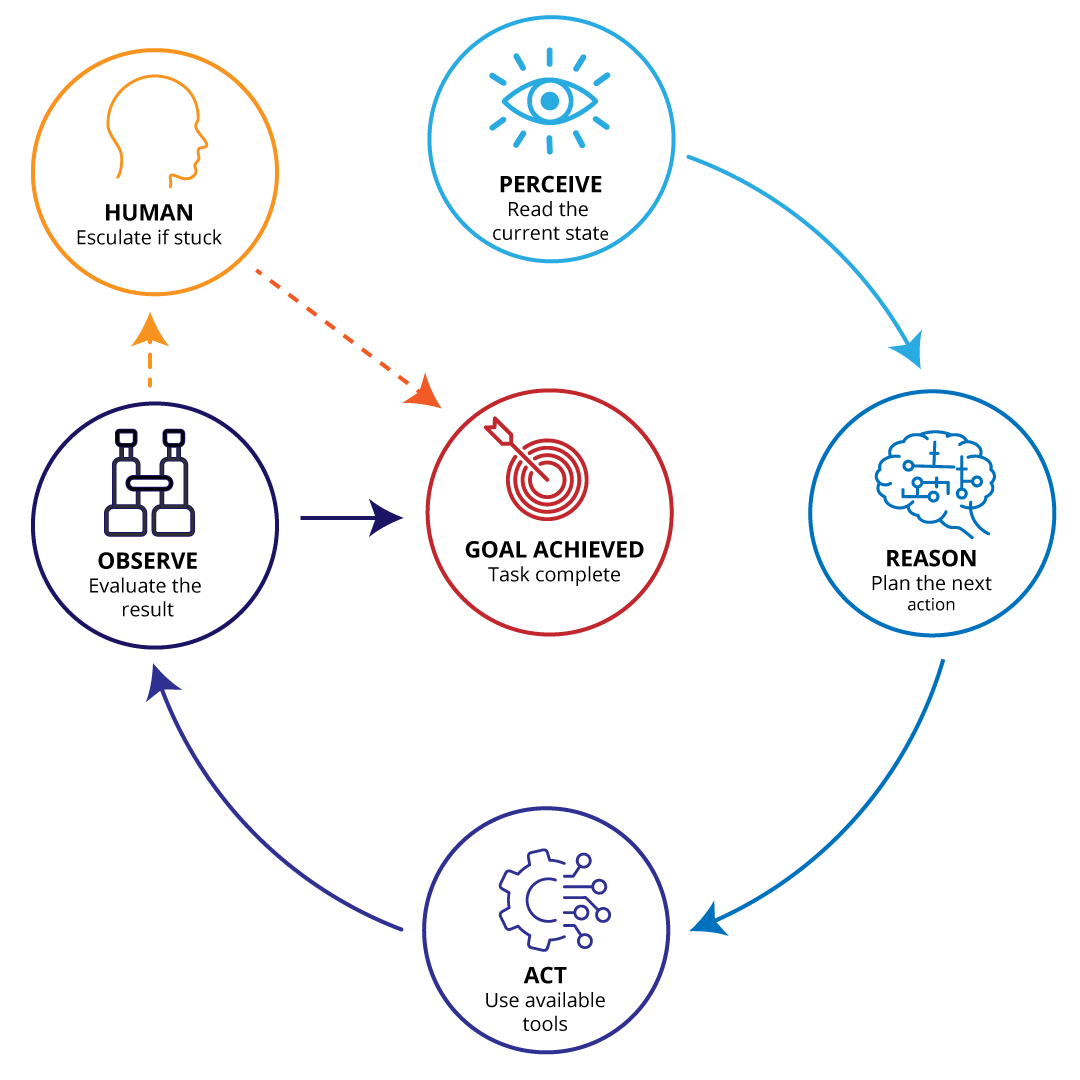
Real-world examples already in use
Agentic AI isn’t hypothetical. It’s popping up everywhere. Here’s what it looks like when it’s actually built into products you might already use.
Email & Calendar
Copilot for Microsoft 365
- Drafts emails using context pulled from your recent conversations and documents — not just what you type
- Scans every attendee’s calendar to propose meeting times without the back-and-forth
- Condenses long email threads into a summary and surfaces the actions that need your attention
Superhuman
- Learns your inbox patterns over time and triages accordingly — so what matters rises, what doesn’t doesn’t
- Drafts replies that match your voice and tone, not a generic AI voice
- Times outgoing messages based on when each specific recipient is most likely to open them
Research & Analysis
Perplexity
- Searches the web and pulls related topics simultaneously, not just the exact query you typed
- Cites every source so you can verify rather than just trust
- Delivers structured research reports instead of a list of links to chase down yourself
Google NotebookLM
- Ingests your own documents — PDFs, notes, reports — and treats them as the source of truth
- Synthesizes findings across multiple files at once, not one at a time
- Generates summaries, study guides, and analysis from your material, in your context
Customer Support
Intercom
- Reads a customer’s full order history, payment status, and past tickets before composing a single word
- Suggests personalized responses based on that specific customer’s situation, not a template
- Hands off complex cases to a human rep — with all relevant context already assembled
Zendesk
- Checks purchase eligibility automatically before escalating a refund request
- Categorizes tickets based on actual content, reducing manual sorting
- Drafts responses that link directly to the right knowledge base articles for that specific issue
Software Development
GitHub Copilot
- Reads issue descriptions and pull request comments to understand what actually needs fixing
- Explores related files in the repository — not just the file you’re looking at
- Suggests targeted code changes and opens pull requests automatically
Cursor
- Understands the entire structure of a codebase, not just the file in front of it
- Suggests fixes based on error messages and surrounding file context together
- Runs tests after making changes and iterates on failures without waiting to be prompted
Why now?
The ingredients for agentic AI have been quietly assembling for several years. Large language models became capable enough to reason reliably. Tool-use APIs matured, letting models call search engines, run code, and interact with external services. Computers got cheaper.
“And new blueprints—like giving AI a ‘think-out-loud’ routine, teaching it to follow step-by-step recipes, and forcing it to deliver answers in organized templates—made it possible to build reliable, multi-step workflows on top of these AI models,” says David Graves, Margraffix IT director.
The catalyst was the combination: a model smart enough to plan, paired with tools powerful enough to act. Once those two things connected, the door to genuine agency opened.
The trust problem
Here’s the tension at the heart of agentic AI: the more capable the agent, the more you need to trust it — and trust is hard to establish with systems that can act without asking first.
When an AI sends an email on your behalf, deletes a file, or makes a purchase, mistakes aren’t theoretical. They’re significant. And unlike a chatbot giving a wrong answer, an agent taking a wrong action in the world can have effects that are difficult or impossible to reverse.
This has led to a growing focus on what researchers call “human-in-the-loop” design — building systems that pause and verify before taking irreversible actions, maintain transparency about what they’re doing and why, and gracefully handle situations they weren’t designed for.
The Minimal Footprint Principle
Leading AI safety teams argue that well-designed agents should request only necessary permissions, avoid storing sensitive information beyond immediate needs, prefer reversible over irreversible actions, and err on the side of doing less when uncertain about intent.
Multi-agent systems: AI teams
A further frontier is multi-agent systems — networks of AI agents that coordinate, delegate, and check each other’s work. One agent plans, another executes, and a third reviews. The architecture mirrors how human organizations work: specialized roles, handoffs, oversight.
These systems can tackle problems of a complexity that single-agent approaches can’t handle. They also introduce new challenges: how do you ensure one agent doesn’t trust another blindly? How do you maintain accountability when a task passes through multiple AI hands?
What this means for you
Whether you’re a developer, a business leader, or just a curious observer, agentic AI is likely to touch your work sooner than you expect. The question isn’t whether to engage with it, but how to do so thoughtfully.
For builders: the design principles matter enormously. An agent with too much autonomy and too little transparency is a liability. Build in checkpoints. Make actions auditable. Assume failure modes you didn’t anticipate.
For users: understand what the agent can and can’t do before handing it the keys. Treat it like a capable but new employee — talented, fast, but in need of clear scope and occasional oversight.
For everyone: the norms around agentic AI are still forming. The decisions being made now — about how much autonomy to grant, how to assign accountability, what guardrails to require — will shape this technology for years. That conversation deserves broader participation than it’s currently getting.
“Agency is not a feature. It’s a new category of relationship between humans and machines — one we’re still figuring out how to navigate.”
The bottom line
Agentic AI is the most significant architectural shift in how we use artificial intelligence since the arrival of the modern LLM. It moves AI from the background — a smart autocomplete, a tireless search engine — to the foreground, as a system that acts, adapts, and accomplishes.
That’s genuinely exciting. It’s also genuinely consequential. The best response to both of those truths is the same: pay attention, think carefully, and don’t sleepwalk into a world you didn’t intend to build.
Recent Comments